

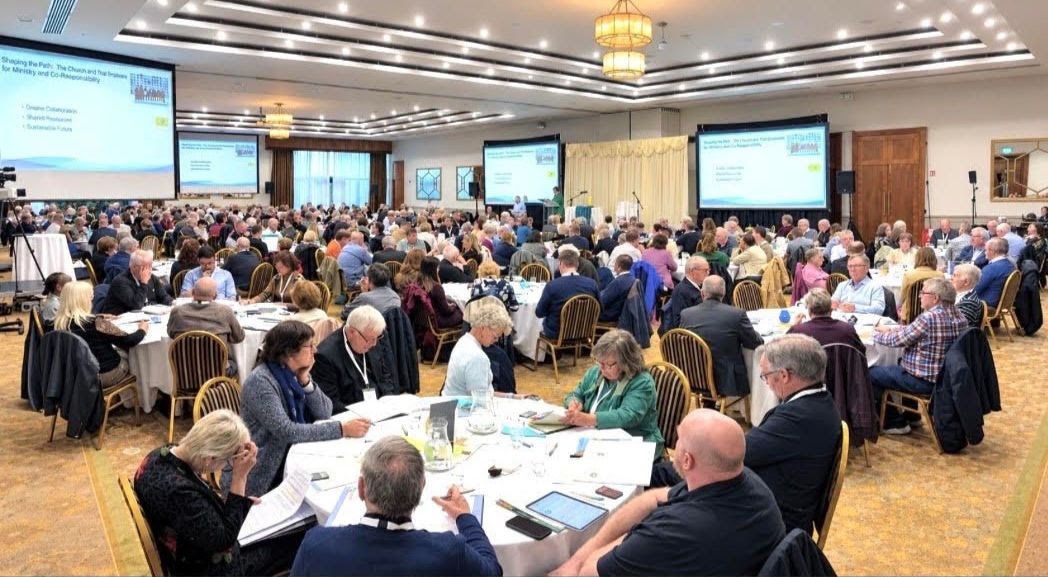
Five members of ‘We Are Church’ – Anne Harte Barry, Denise Boyle, John Colreavy, Noelle Fitzpatrick and Jo O’Sullivan – participated in the Irish National Assembly in Gormanston, on Saturday, 17 October. We were privileged to do so and share news of it here, through personal reflections of the event.
Jo O’Sullivan
There are lots of criticisms I could level at the whole Synodality project as it has been carried out in Ireland, not least in that Saturday’s way of working, as in many aspects of the journey that brought us there, were, in many ways, the complete opposite of synodality. However, I respect that it was a genuine attempt to begin becoming a synodal church, so I felt able to work positively within the constraints.
The day was organised incredibly well. Great credit is due to all those who made it so. The day began with prayer and the realisation that God was the centre of the endeavour and with us individually and collectively. Before we embarked on recording any of our recommendations in each of the pathways, we were again called back to invoking the Holy Spirit to be with us.
After a short introduction to each pathway, we had twenty minutes to discuss our views with seven companions around the table. While we had different understandings and different priorities, our conversation was at all times cordial and respectful of each other. It became clear that some of the proposals meant different things to different people. After the twenty minute discussion, there was an opportunity for individuals to address the room. We knew in advance that each person was allocated one minute only to do so, as it was envisaged that many people would want to speak to the whole assembly. Four of the WAC Ireland delegates delivered such personal submissions over the course of the day.
As a consequence of the round table discussion and the personal interventions, especially those from members of the working groups that had put their proposals forward, I found that I changed my viewpoint in a couple of instances. What appeared initially to be a very positive proposal might need to go back to the drawing board. Members of the working group on women had asked for an ombudsperson to oversee the involvement of women as equals at every level of church, but the wording of the proposal offered a National Office for women. I’m convinced that memories of the National Women’s Council of some years ago, and an apparent lack of action taken as a result of their work, had a big influence on the recommendations the delegates made there.
The choices of recommendations we could make were,
- Highly recommend
- Recommend
- Needs further discernment
- Do not recommend
The percentages choosing each option was shown immediately after each vote count.
As the day progressed, we continued to pray and select our recommendations as best we could.
From a personal point of view, I was encouraged with the result for the proposal seeking a change in the vocabulary used in church documents regarding the LGBTQI+ community. 61% voted between highly recommend (41%) and Recommend (20%). While it only scratches the surface of what is needed to change regarding recognition and integration of our queer brothers and sisters, it is a start.
While there were a number of proposals that dealt with the position of women, their wording was sometimes problematical, leading to results which may seem to suggest something other than what many delegates intended. In my opinion. I could not but feel that none of them reflected accurately the loud cry that was evident from the nationwide consultation back in 2022. This called for the full equality of women in Ireland at every level of the church. There is still much work to do.
Noelle Fitzpatrick
It was a privilege to be part of the Synodal Assembly on 17th October.
As imperfect as the journey so far has been, it was a significant step forward in learning how to ‘do’ synodality. We make the path by walking it. Round table discussions and short interventions from the podium engaged lay and ordained in articulating differing perspectives. Conversations were short but robust, they were respectful and rooted in prayer. It was, (for me), very important to be deepened and challenged by hearing varying perspectives, all passionately held.
It was a serious responsibility to be open to the Spirit in all, listen to all and to vote on the 35 proposals after careful discernment. There was an atmosphere of reverential seriousness to the day if I can put it that way!
Before the Assembly, more time for the working groups to tease out and present more fully articulated wording on the 35 proposals being voted on would have been better. Time is an essential ingredient of synodality. I prefer to make no assumptions about why people voted as they did. Facile and polarising analysis will not serve the common good. The Spirit of God always finds ways to work with and through our haste, our inertia, our fear and all of our blind imperfections! For me, it is critical to remain open and ever vigilant against hardness of heart.
I experienced a range of emotions on the day – amongst them gratitude, hope, some sadness and a little anger. I expect it was the same for many. We move on together from there having voted on proposals that must now be accountably actioned. The task is to pull together to reposition and re-ignite the Church for effective mission for today. The Synodal Assembly was a very early milestone, but a significant one.
Anne Harte Barry
In general, I found it a synodal day, with openness and a future vision. It was very well organised and conducted. I found the synthesis document was clear and for the most part, captured the synodal movement and the work of the synodal groups very well. I admired the sensitivity of the Bishops and clergy remaining at the tables for the Eucharist and appreciated even more, those among them who participated among them as one with the faithful.
While I think the synthesis was in most par excellence, there was an unfortunate lapse regarding Pathway 2 ‘The Church as a Community of Belonging’, Proposal 6 ‘A national office for women (mainstreaming women’s inclusion’. It was clearly submitted in a raw and unfinished form, with the Working Group on Women confident that they would be afforded an opportunity to hone and clarify it. Unfortunately, that opportunity was not afforded to them, so the proposal as presented was rejected. As anticipated one the day, this rejection was seized upon, misused by some media to misrepresent the whole work of the Synod. What a pity the opportunity for clarification had not been taken during the synthesis work!
I was saddened by some very narrow dated theological understandings, but happy or relieved that we still opted to keep open at least to some movement around diaconate and ordination. I appreciated some shifts in relation to women and to our LGBTQI+ sisters and brothers but am aware that there is a very long way to go…
I am cautiously hopeful. There was much talk of relevant accompaniment and formation. I hope it will be true formation – based on exploration, journey, accompaniment, search and relevance, rather than on certitude, dogmatic catechesis and training. So tiny steps…in the right direction and for the most part in a slowly growing synodal spirit
Denise Boyle
On arrival at the Synodal Assembly in the City North Hotel in Gormanston on Saturday 17 October, I sensed excitement, energy and hope. Yet there was anxiety too and a little fear that we would not meet the expectation for change that many Irish people see as urgent and essential, if we are to be a church in touch with the ‘signs of the times’ in 2026. This refers particularly to Gospel justice, whereby we honestly review the place and role of women within the church; and how we accept and treat our LGBTQI+ sisters and brothers.
The 300 participants, roughly evenly balanced with women and men, sat together as equals, at round tables of eight. We were keen to get down to the business of discerning and voting on the 35 proposals set out under the ‘Five Pathways’ in the Working Document. (Working Document)
These proposals reflect the five-year nationwide Synodal journey of prayer, honest sharing, listening, and discernment, embracing the hope and the dreams of Irish parishioners, women, youth, men and those on the edge or margins of church life. Sadly, there appeared to be few from the latter group present at the assembly, leaving participants to speak for, rather than to hear their voice directly.
The day was well planned and executed, ensuring that we achieved our aim of voting on each of the 35 proposals. In addition to good, comprehensive introductions to each Pathway, interventions from participants just before the vote were valuable. They provided further insight or explanation of the context for the proposal.
Unfortunately, the media in citing what appeared to be the negative response to the proposal to set up: ‘A National Office for Women’ in Pathway 2, failed to provide the context of an important intervention. It seems the Working Group on Women believe the appointment of an ombudsperson for women, who would engage with the Bishops’ Conference and their committees, is a more practical option.
Overall, I believe that Saturday was a significant and hope-filled moment on the Irish synodal journey. Missing was a clear reference to how we respond to ‘the cry of Earth and the cry of the Poor’. Yet guided by the Spirit, underpinned by Gospel justice, we are slowly moving towards the goals of equality and inclusivity for all…
John Colreavy
For me, the Irish National Synodal Assembly on 17th October 2026 was a historic occasion and I feel grateful to have had the opportunity to be there. The tone of the conversation at our round table was respectful and there was no attempt by anybody (bishop, priest or lay) to dominate the conversation. I was aware of the huge amount of work put in by those who participated in the working groups sometimes under great time pressures as well as the work of the National Synodal Team.
When voting on a specific proposal it was sometimes difficult to decide whether to look only at the particular wording or to take into account the “What, Why and How” in the accompanying explanatory text. At face value, all the motions seemed worthy of some support.
However, I feel that the process leading up to and on the day was not particularly synodal. The scope for conversation and listening has been limited and, at the end of the day, the final outcome will be determined by the “Bishops Discernment”.
I remember the great energy in our parish deliberations in 2022 but afterwards there was a loss of momentum, when nothing seemed to happen so that I suspect that synodality is not an issue in most parishes.
Whilst I am disappointed that the fundamental issue of equality for all in our church has not been explicitly grasped in stronger terms, the proposals have the potential to create a space where these questions can be asked and progressed. For a church to become synodal it needs to practice synodality and I hope there will be plenty of opportunities to do so 2027.
______________________________
And so the journey continues. The work of WACi now turns to discerning how we play our part in furthering the work of the synodal process through encouraging the implementation of the 35 proposals.