

WOMEN RESISTING PATRIARCHY
A Divine Calling
Soline (Vatinel) Humbert CWC 14 March 2026
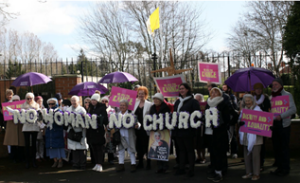
I was born in France in a Catholic family, the second and last child, with just one older brother. My mother was parish catechist. In many ways I am a child of the Vatican 2 Council: I made my first Holy Communion while the Council was in session. While I grew up with an awareness that it was more of a man’s world, and that it was unfair, [French women only started voting in 1945, after the 2nd World War] I do not remember questioning the status quo in the church: it was what it was. My brother hadn’t been an altar boy and I hadn’t felt the desire, so I hadn’t encountered the discrimination. In many ways I was completely unaware of the reality of power imbalance in the church.
All that was going to change and change in quite an abrupt and surprising way. I had gone to Ireland for my University studies, and it was there that at Easter in my first year (1974) I had an experience of God’s Love. It was a wonderful experience, one that I would find out later a great many people are blessed to have in their lives.
That was very well, but then a few months later the real shock came when I experienced within me a call to the priesthood (presbyteral ministry).
I have often been asked how this call came to me. I do not recollect one single dramatic moment. It just surfaced. Because I live by the sea, I have used the analogy of a rock which is hidden under water, but which surfaces, becomes visible at low tide. That call to priesthood was like that rock.
That call was profoundly destabilising, totally disorientating. l had grown up with the complete belief that God called boys, men to the priesthood ,and only them, and I had never questioned it.
So now it was my whole sense of identity which was thrown into question: if only men got that calling, what did that make me ? I knew I was a girl, a young woman… but a girl wouldn’t experience that call, so what was I?
My whole world had been turned upside down.
The calling was strong, solid…like a rock.
It totally derailed my life.
I cannot stress enough that the calling came unbidden. I had other plans for my life. I never sat down and thought: I am going to resist the patriarchy. In fact I am sure that the word patriarchy wasn’t in my vocabulary!
The calling precipitated in me a breakdown. I had confided with the University chaplains, but while they were good men, such a calling didn’t fit in their own belief system. Isn’t it the case that God calls only men to that ministry. No girl, no woman had ever said to them she had such a calling.
It was a very lonely and agonising time.
I would often pray before the Blessed Sacrament in the College Chapel a very anguished prayer: “Do not call me, your church doesn’t want me “.
How could I live, how would I live, with that vocation blocked?
In Ireland, a very conservative Catholic country in the middle 1970s, for a girl to say she had a call to priesthood was as far-fetched as saying she came from the planet Mars. Outlandish.
To put it into context, It would be another 20 years before Rome allowed girls to serve as altar servers.
In 1976 Pope Paul 6 reaffirmed the closed door to women priests. I resigned myself. Someday women would be priests, but it was over for me.
I finished my degree, got a job, married, had two sons. While I had gone and studied theology, I had completely put behind me that calling, at the conscious level that is. There were fleeting moments when it would re- surface, but never long enough to become fully conscious again.
In 1990 all that was going to change. Again I want to emphasise that it was not the product of a decision, something I controlled. I experienced a deep and arduous spiritual process: I had been turned inside out, stripped of everything. And then it is as if the sea covering that rock-like vocation to the priesthood completely receded, leaving it exposed in full view. By October of that year, very much to my surprise, I discovered that my vocation to the priesthood was alive and well.
In 1974 The call had shattered my inner stained glass ceiling, the one in my mind (After all God does call women!), but I was still not capable to respond a wholehearted yes.
In 1990, I was able to say that ‘Yes’, like Mary did at the Annunciation. Now, like Mary, I also asked a reasonable question: ‘How will it come about ? I am still a woman, and now I am married with children? And your Church hasn’t changed”.
Like Mary I heard in prayer that it would be the work of the Spirit. So I said Yes.
That was 36 years ago and that calling has never left me.
I once gave a speech in which I said that the Annunciation was radically subversive of patriarchy and established a precedent: God directly asked Mary who gave her consent without asking the permission of her father, fiancé or religious authorities. God’s freedom to choose whom God wants, and Mary’s freedom to respond without the say-so of any man. The God of Mary isn’t a patriarchal God. Joseph was told afterwards: it was ‘fait accompli’. His role was to believe and accept what God had done.
How did we end up with a patriarchal God in the Church?
I now found myself in the strange position of being a living, breathing contradiction to the patriarchal church setup.
It wasn’t an ideological position, a stand that I had taken. It was the outcome of my faith.
It wasn’t that I was rebelling against patriarchy, saying no to the limits imposed. It was that my deep Yes to God’s call set me up in opposition to the church laws. Yielding to God in faith (‘Let it be done unto me according to your Word’) meant
resisting patriarchy. Between resisting God and resisting patriarchal churchmen, I chose the life- giving option !
I soon realised that calling which had taken place in the most intimate depths of my being wasn’t to remain a private reality. It was to be made public.
I started going to the church leaders and would meet nuncio, Cardinal, archbishops, bishops.
I brought Good news but of course it couldn’t be received as such. If God really did call women to the presbyteral ministry the whole patriarchal house of cards would collapse. Its foundation is that the God of Jesus Christ does NOT call women to the ordained ministries. Most, if not all, of these high ranking churchmen had never met a woman with such a vocation.
Of course they denied I had such a vocation. I couldn’t have: I was a woman.
I must say these meetings were sometimes exceedingly painful. To tell the truth and not to be believed wasn’t easy.
I also started going public in the media: It was a kind of “coming out”. I was by nature a very private person, now my privacy was gone: my name, my photo and my story made headlines :
“Mother Wants to be Father”.
I didn’t find it easy to be exposed like that, really an object of curiosity: There was ridicule and worse, verbal violence as well as anonymous letters and phone calls with threats of rape. It was an eyeopener: A woman with a vocation to the priesthood was drawing out the deep misogyny in the patriarchal mind of men.
But a great many women also were opposed to me: To them too I represented a threat.
This was a crucifying time for me which I described in a poem and an image:
A Woman of Sorrow
An object of curiosity or rejection,
she hangs,
bloodied and bruised,
stripped of her dignity,
crucified on the cross
of her calling.
Above her head it is written:
“Woman priest”
The blind crowd jeers and mocks,
spitting God, Scripture and Tradition
to her face
‘God chooses only men’.
‘You’re a neurotic, get your head examined’.
‘You lack humility, you want power’.
If only she would recant,
confess her deluded arrogance.
Many turn away,
a few stand by her.
For eighteen years now
she has been bound
her womanhood derided
her youthful life ebbing away
in an endless agony.
Only silence answers her screaming broken heart
Church – forsaken
God – forsaken.
Through her tears
she sees Him at her side
the loving, gentle Christ
who called her, still a girl
to serve Him.
Bloodied and bruised,
crucified on the cross of His calling,
and yet smiling:
‘Woman, they did not receive Me,
and so they do not receive you,
for they do not love enough’.
Patriarchy is first and foremost a matter of mindset. Living in patriarchal systems for millennia has shaped our worldviews and our God views.
Many women had their inner stained glass ceiling still intact, and indeed it was often a very low ceiling! Somebody like me would disrupt all this.
Meeting one other woman who had that same calling, a much older woman, brought another development: Now I asked myself: “How many women are going to go to their graves with their calling never acknowledged?”
Indeed, how many? I believed it was important to end that invisibility, that silence. The reality was to be known and with it the suffering of women unable to live out their calling. So I started a group with my husband and a priest: Brothers and Sisters in Christ.(BASIC)
The name was important.
In the Gospel Jesus tells his disciples: “Call nobody ‘ father ‘, for you have one father in Heaven and you are all brothers and sisters”.
Our church relationship is a fraternal/ sororal one, as siblings. It is not a patriarchal one of father(s) – daughter(s). BASIC was about a new relationship between women and men in the church, a partnership of equals.
We started a petition requesting the opening of all ministries to women and the removal of all sexist rules and regulations.
With the petition we made clear there was an alternative vision of church, one in which women were equal. We found out that this resonated with a lot of people, but of course it increased the authorities’ fear of change.
When I had said that Yes in the depths if my being, little did I know what it would mean, what adventure I was embarking on.
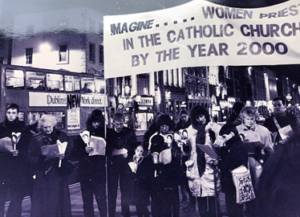
In 1994 we declared the 25th of March, feast of the Annunciation the first Day of Prayer for women’s Ordination and stood in the main Dublin Street for a prayer vigil. Our banner proclaimed:
“Imagine Women Priests in the Catholic Church by the Year 2000”.
Yes , by the year 2000!
Wildly optimistic.
But of course the patriarchal resistance was now at its peak. I experienced John Paul 2’s encyclical Ordinatio Sacerdatolis (1994) as a very violent pronouncement. It was an attempt to definitively close the door to women’s ordination, to stop us believing and hoping change would happen.
In 1995, at a public seminar I named what I had experienced from the official church leadership as spiritual abuse. It was at a time when the dark reality of clerical child sexual abuse was becoming known. I saw both were rooted in power, in domination.
In my case I perceived men like the Pope and other churchmen as trying to alienate me from what was truest and most alive in me, God’s presence and action in me.
– “When I tell you that you don’t have a calling to priesthood, do you not hear God speaking to you?”
– “No, I hear my archbishop speaking to me”.
When the patriarchal order, which is in reality a dis-order, is challenged, it unleashes repressive measures. These reveal, bring into the open, the truth that the patriarchal rule is fundamentally oppressive and violent.
When we hosted the first International Conference for the Ordination of Women in Dublin in 2001 this was seen as a big challenge and every possible abusive action was taken and pressure exerted by Rome to collapse the Conference.
It became very clear to me early on patriarchy rules by fear. Its power over us is our fear. I would have to confront my fears, again and again as they would arise.
I think that by now I have made it clear that the way my life has unfolded is not according to a grand strategic plan to bring down patriarchy.
Which is not to say that it isn’t challenging that patriarchal order.
But ultimately is it not true that the Holy Spirit, the Ruah, which blows where it wills, is NOT the spirit of patriarchy? And is NOT bound by man-made rules? And so it is for anyone led by the Spirit.
I had been asked for years: “When will you start presiding a Eucharist? Why are you waiting for Rome’s permission which will never come?”
To which I replied: I am not waiting for permission from Rome, but I want to know that’s what God wants me to do. I do not want it to be an ego trip, my ego asserting itself, a gesture of defiance . The Eucharist is the complete opposite: it is self- giving”
– “And how will you know?”
– “I don’t know how I will know, but I will.”
And so it came to pass: I was given several signs, including the gift of a chalice and paten. On the feast of the Epiphany 1996, I first presided at a Eucharist celebrated with three men, three wise men ! It was both the most natural and the most wonder-full thing for me to do. I didn’t have to play a role, only let myself be and do who I am. The wine used was chateau St Marie: Mary ‘s Wine!
That first celebration of the Eucharist was not in public.
Gradually, in an organic manner, over the next decade I came to preside at small groups celebrations taking place in our homes or hotel spaces. One such group was Leaven , with priests who had married and who had to leave their formal official ministry.
It became known more widely and more openly but a big turning point was yet to come:
In 2006 the main Irish television network asked to make a film on my calling and to include a Eucharistic celebration on the feast of Pentecost.
That was another big pushing out of the boundaries.
I braced myself for the fall out when it was broadcast nationally in November 2006, but I received a lot of support from individual Catholics
The response of the Church authorities remained the same: Complete Silence: Ignore publicly.
But of course that meant I found I could no longer be employed and or minister in any capacity in the official institutional church. I had been offered a position as Pastoral Assistant in a parish and that was withdrawn.
It was a big price to pay, and it was really very painful.
But I had my integrity and my freedom.
I had just completed my training as a Spiritual Director/ guide and so I have been self- employed for the past 20 years, and very fulfilled in that ministry.
I did wonder whether that ministry of spiritual direction would lessen or even extinguish completely my sense of calling to the presbyteral ministry, but not at all ! It has remained as strongly as ever, urging me on and so I continued, presiding at Eucharist and advocating for women’s ordination in writing, interviews, presentations, protests.
A long time ago a friend had planted in my mind the idea of writing the story of my vocation. In 2020 I finally started writing it and it was published last year: A Divine Calling- One Woman’s Life Long Battle for Equality in the Catholic Church.
It was launched on the first of October, feast of St Thérèse of Lisieux, in acknowledgement of her own sense of vocation. And it was in the Loyola Institute in that same university, Trinity College, where I had first received that “Divine Calling”.
It was launched jointly by a woman, and a man, a Jesuit priest.
The book has been very well received with good reviews including Catholic press and in depth interviews in mainstream media which have served to highlight the issue.
My main purpose in writing the book was twofold:
1) to leave a record, bear witness to what God had been doing in my life with that sense of vocation in a patriarchal church institution which denies it.
2) to open up and encourage conversations where there is honest and courageous speaking and listening. Many other women have that same calling but feel they cannot share it.
I wrote in the book that it was my gift, my offering to the Synodal process we have been engaged in, doubly so in Ireland as we are about to complete our own 5 year Synodal Pathway. While the issue of women’s equality, including ordination, has been raised very strongly in Ireland (as in many other parts of the world), there is a very determined effort to water it down and to exclude yet again women’s ordination.
So my book is an act of resistance in the face of this attempt at erasure.
Only last month I was able to have an impromptu conversation with one of our newest bishops. I told him very frankly that voices like mine are challenging because we denounce the spiritual abuse , but so were the voices of survivors of clerical child sexual abuse. I also gave him a copy of my book, which he promised he would read.
In a subsequent email exchange he wrote :
“I would like you to know that I respect your sense of priestly vocation”.
Now I do know “one swallow doesn’t make a Summer” but yet I want to acknowledge this is the most affirmative response – and in writing – from a bishop I have ever received in 50 years.
Another step on this very long road for freedom and equality.
I want to conclude with something which may seem at first sight to be counter intuitive after all that I have shared about the suffering involved in being a woman with a priestly vocation.
It is this :
JOY is the ultimate resistance!
That joy is the Joy Jesus promised to his disciples, his own joy would be in us. The unfailing sign of his Presence .
And it is that same joy which filled Mary of Magdala, commissioned by the Risen Christ to “Go and tell!”.
Like her we are messengers of Resurrection. Christ is Risen and women are rising ! Love is stronger than death, stronger than patriarchy.
MAGNIFICAT!