

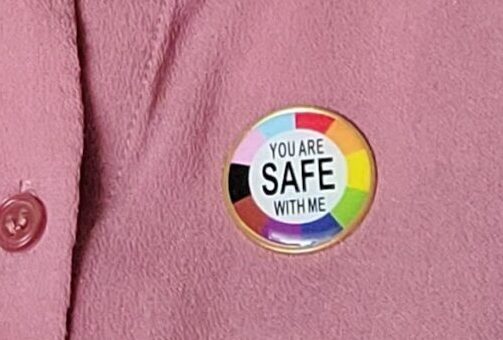
An inclusive church, open and welcoming to all, which does not marginalise people because of their sexual orientation, marital status or for any other reason.
GNRC is the international advocacy group which
“brings together groups and their members who work for pastoral care and justice for lesbian, gay, bisexual, transgender and intersex (LGBTI) people and their families. The Network works for the inclusion, dignity and equality of this community in the Roman Catholic Church and wider society.”
Each day began and ended with prayer and great thought had obviously been put into the preparation of such sessions by a variety of people. It was always a rich combination of music and song, Scripture Readings, Reflection and sharing. Our Sunday Celebration of the Eucharist was an incredibly uplifting and joyous occasion, presided over by Fr. James Alison.
One of the first things I observed during the weekend, was that the usual gender balance in church related gatherings was overturned. There were many more men in attendance than women. Spanish was the dominant language and while all the inputs during the assembly were delivered in both languages, being monolingual was a bit of a drawback for casual, informal communication.
Many workshops and talks took place over the duration of the Assembly. The first such group session I attended was the Womyn’s Group. There was really just time in the hour allocated for all of us for all to introduce ourselves. I met women who have worked tirelessly for many years, not just for the inclusion of LGBTQ+ women, but for women in general. Among us was Sr. Maria Luisa Berzosa, who is considered to be one of the women to have had the ear of Pope Francis.
The general consensus of the group is that we, as women, must work to claim our place in the church – even within the context of Christian LGBTQ+ groups (this surprised me initially, but it made sense when I remembered my amazement realising how the breakdown of attendance appeared to be 70%-30% in favour of men - my own guesstimate) It was considered to be such an important area that the group decided to convene again during free time the following day. Unfortunately, I missed that follow-up meeting.
Subsequent talks and workshops were equally informative and inspirational in their own ways. The first of which was by James Alison, a well-known and respected English Catholic priest and theologian. Alison, a gay man himself, is noted for his work on LGBTQ+ issues, and for his application of René Girard's anthropological theory to Christian systematic theology.
He titled his input, Opening up spaces for catholicity in the wake of the synod
He began with a whistle-stop tour of the history of scapegoating of LGBTIQ+ community and is of the opinion that the LGBTQI+ community no longer needs to “beg for acceptance” within the Church. The scientific realisation in the 1950s that there is no pathology proper to homosexuality, that it is, in fact, a natural variation within the human condition, is known and accepted in the Vatican. The LGBTQ+ community has a lot to offer modern society, particularly young straight men. As a community, it has had to struggle to navigate a heterosocial society where it is accepted that only heterosexuality is “natural”. Patristic society has been ordered to boost that norm, with men being accepted as the natural leaders and women being the nurturers. It relies on “strong” leaders who dictate what is right and what is wrong and followers accepting blindly in order to belong. Such a society is now crumbling. The erstwhile structures of men and women “knowing their place” has broken down and trying to maintain them has led to polarisation – the growth of the Incel culture is an example. During a time of massive changes, a community that has been there already navigating a culture outside of what is natural for them, has a lot to offer. A new type of belonging is needed, where society is made up of equals - all equally gifted and equally flawed, seeking the way forward. In the Spiritual sphere, “Where sinners are gathered to pray, Jesus is in their midst. Where the self-righteous gather, there is no room for Jesus”.
As far as James is concerned, the time has come for the LGBTIQ+ community to move from being supplicants, to one of being the generous adults in our church.
---------------------------------------
The title of Renato Lings’ Input was Were not our hearts burning?
I must confess, I had never heard of Renato Lings, but he’s a very impressive person. He gave us his personal background and his reasons for following the path of integrating gender and sexuality with the Christian faith. Born in rural Denmark to a family steeped in religious observation, he realised at a young age that he was different, that his sexuality was sinful as far as his Christian faith was concerned. While it caused him deep depression for many years, it also caused him to investigate why the Christian faith was so homophobic. Rather than just accepting what others said, he went right back to the source, studied theology and Biblical Interpretation. He has done incredible work to show how the “clobber passages” in the Bible, those passages that are claimed to prove that God distains any sexual activity other than married heterosexual love-making, are open to interpretations other than those generally accepted. He paid tribute to the “Helping Angels” who helped him along the way to reconciling his sexual orientation with his Christian faith, mainly
- John J Mc Neill - The Church & the Homosexual, Taking a Chance on God
- Brian Doyle
- John Boswell - Christianity, Social Tolerance & Homosexuality 1980
- Mark Jordan - The Invention of Sodomy in Christian Theology (the word Sodomy, a church invention, not in the Bible)
- James Allison - Faith Beyond Resentment
Renato holds degrees in Spanish, translation studies, Latin, Greek, Hebrew and Nahuatl (Aztec), as well as theology and biblical interpretation and has written and taught extensively on biblical interpretation, translation, and issues relating to gender and sexuality. He lives in Spain.
The bulk of his input concerned two biblical stories, the story of Sodom and that of Paul’s meeting with the Eunuch on the road to Gaza. The Sodom story is one of the aforementioned clobber passages. He explained how stories can only be read within the context of the culture of the time in which they were created and the audience for whom they were being written. Taking all of the historic background, and the multiple re-translations of words that have occurred down the centuries, the conclusion that Renato (and other Bible Exegetists) have arrived at, is that the sin of Sodom and Gomorrah was not of a sexual nature, but rather one of inhospitality (to Lot and his family).
When examined in detail, the story of Paul’s meeting of Eunuch on Road to Gaza is, in fact, a story about inclusiveness and ever-increasing circles of belonging – a faith that had been originally considered to be for the Chosen People of Israel had now been shown to reach out in ever-widening circles to include all who wished to be part of it. No preconditions were sought or imposed.
The following morning’s Plenary Session was a joint presentation by Cristina Inogés and Sr. Maria Luisa (mentioned before)
Both Maria Luisa and Cristina shared their personal experience of being at the heart of the Synod on Synodality and gave their recommendations as to where we go from here. They stressed the importance of sharing our hopes and concerns as widely as possible – in particular with people who were involved in drafting the Final Report, those people who will be involved again in the evaluation of its implementation. The Report was accepted in its entirety by Pope Francis so is now part of the magisterium of the church. Bishops have a duty to implement its directions and need to be called to task if they don’t do so. We need to demand transparency and accountability from them. If we do not stand up and speak out, we can’t blame others for not hearing what we have to say.
Cristina and Maria Luisa shared that the acronym LGBTQ+ was used frequently outside of the sessions of the Synod, but admitted that it generated fear and demonstrated prejudice in some while igniting passion and enthusiasm in others. More needs to be done. They shared their frustration and hurt that the LGBTQ+ community wasn’t identified by name in the final document.
Cristina said that she feels secure in the knowledge that progress made by Pope Francis in the whole area of LGBTQ+ acceptance and inclusion will not be rolled back. She is withholding judgement as to what further advances, if any, will be made by Pope Leo. This is why it is so important to keep up the pressure.
--------------------
That was followed by a Speaker from Nigeria, a young man who had to remain anonymous for fear of reprisals when he returned home. We were under strict instructions not to take photographs or videos during his talk. He was one of six or seven gay men from Nigeria and Ghana who were brave enough to come to the Conference. Lenny spoke of his necessity to play a part all his life. African men are expected to get married when they reach a certain age. In fact their families often arrange the marriage. Lenny had a wife and has children. When he risked confessing to his wife that he was gay, he was totally rejected and has not been allowed to see his children since. While he has felt supported by one or two “good priests”, at different stages of his life, he feels very hurt by the church in general “Which should be a place of safety and belonging but is often even worse than civil society”. Younger people in Nigeria now are much more tolerant of different sexual orientations, but it’s still the case that support groups have to be very careful and maintain a lot of secrecy. What impressed me most about the African lads was that their faith in God was joyful and without a trace of bitterness. They can clearly differentiate between “Church” and “Faith”. It was also made clear by Davis, a man from Ghana that we have to respect African culture and not try to impose solutions that seem right to us. They may be completely wrong in the African context. What the Africans need to know most of all is that we have their backs while they find the solutions themselves.
----------------------------
As with all good conferences, an awful lot of the benefit garnered from the GNRC Assembly came outside of the formal sessions. I met and spoke with a broad cross-section of attendees - decent ordinary folk who want to live life and belong in their church as their authentic selves, be that gay, queer, trans, lesbian bi-sexual, intersex or whatever other colour (including straight and cis gender!) They are secure in the certain knowledge that they/we are loved by a Creator exactly as we are – and that how and how we love is much more important than who we’re sexually attracted to. Who we’re sexually attracted to has also been given to us by our loving God so it is wrong that such love is deemed to be an aberration. It is part of the broad spectrum within the human condition and needs to be accepted as such. Having said that, I feel humbled to have spent time with people, who despite having been deeply hurt by a Church, still believe in and care so much for that church that they are prepared to stay the course until they are recognised. As James Alison says, they are not begging supplicants, they are adults who have come through the fire and can teach those of us who have never been so tested in our faith, what it is to love.
I was the first person from Ireland to have attended a GNRC General Assembly in person (We Are Church has participated virtually in the past) and on the final morning I felt compelled to speak. I felt I had to state what I have found to be the case here in my own situation. After explaining that the aims of We Are Church are broader than the inclusivity of the LGBTQ+ community, I confessed I was straight, an ordinary member of an ordinary parish. I pointed out that we were passionate about welcoming and inclusion, but that we found it very hard to connect with LGBTQ+ groups. We perceived there to be a lot of reluctance or disinterest among the LGBTQ+ community to have anything to do with church. So I appealed to those present, to communicate with any LGBTQ+ groups or individuals they might know in Ireland, that people in the general population of church-goers DO want them to engage with us. We can’t be welcoming and inclusive if people don’t come and see. I’ve suggested they be courageous and give us a chance to mend wounds. I’ve asked that they contact us via We Are Church.
I know that is not enough. I know that those of us who want our LGBTQ+ brothers and sisters to know that we have open hearts towards them must find ways of getting out there and meeting them more than half way. We have to start somewhere. No-one of us can leave it up to someone else to do it. We can all find steps we can take if we care to do so.
There’s a very interesting Rainbow map, compiled by ILGA (International Lesbian, Gay, Bisexual, Trans & Intersex Association) which shows how we are faring as a nation in different categories of treatment of the LGBTQ+ community. It also shows how the rest of Europe fares. We’re in 14th place at the moment among the 49 countries in Europe. It’s not too bad, but we still have a way to go. If you put rainbowmap-ilga into Google it will lead you to where you can see the details.
There’s a real fear among the LGBTQ+ community that things are getting worse for them in a lot of places. I think we have to do our best to ensure that in our country and in our church, our LGBTQ+ brothers and sisters, sons and daughter, friends and colleagues know that they belong as equals in our church as in society - that we’re all brothers and sisters in Christ.
Since the Assembly…….
Good things are happening in the Global Church, although there is still a long way to go. It is most heartening to know that over a thousand members of the LGBTQ+ community, with families, friends and allies, walked through the Holy Door in St. Peter’s Basilica on Sep 6 this year, as part of this Jubilee Year’s Pilgrimage of Hope. Before that, they attended a Mass in the Church of Gesu, in central Rome, presided over by Bishop Francesco Savino, vice-president of the Italian Bishops’ Conference.
During the Mass, Bishop Savino quoted words that Cardinal Cobo wrote
“The human person and his or her dignity must be the point of reference for all Christians. Christian communities… cannot stop at mere welcome…. (they) are called to promote a culture of dialogue, accompaniment, and the concrete inclusion of those who wish to journey within the Church”’.
Bishop Savino added
“a Jubilee is the time to free the oppressed and restore dignity to those who have been denied it”.
We believe it is time for us, here and now, to play our part in freeing our LGBTQ+ brothers and sisters from oppression and restoring to them their God-given right as part of our family, without fear of rejection, discrimination or marginalisation.